

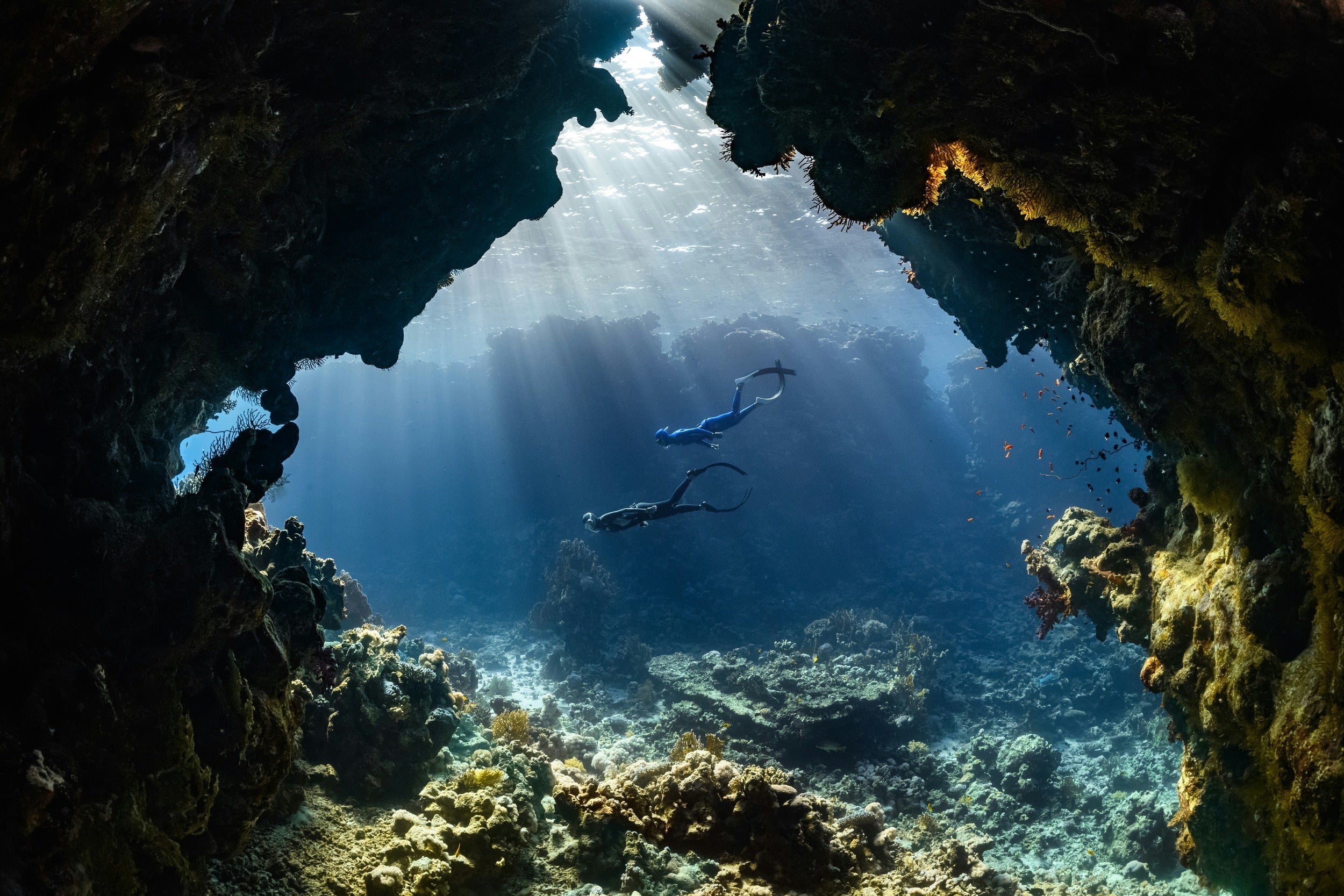
For anyone looking to explore the underwater world, one question often comes up early:
Should I learn scuba diving or freediving?
Both activities allow you to experience marine life, coral reefs, and underwater landscapes, but they deliver very different experiences. One relies on breathing equipment that allows you to stay underwater for extended periods. The other depends on a single breath and a completely different set of skills.
Neither is better than the other. The right choice depends on your goals, travel style, comfort in the water, and the type of underwater experience you're looking for.
This guide breaks down the key differences between scuba diving and freediving to help you decide where to start.

The Fundamental Difference
The biggest distinction between scuba diving and freediving is simple.
Scuba Diving
Scuba divers carry a cylinder filled with compressed breathing gas and use a regulator to breathe underwater.
Because divers can continue breathing throughout the dive, they can spend longer exploring reefs, wrecks, walls, and marine habitats.
Freediving
Freedivers hold their breath for the entire dive.
Each dive begins with a breath taken at the surface, followed by a descent and return before breathing again.
The result is a very different rhythm underwater. Rather than remaining submerged continuously, freedivers complete a series of shorter dives separated by recovery periods at the surface.
How the Underwater Experience Differs
Many people focus on equipment and depth when comparing the two activities, but the real difference is how they feel underwater.
What Scuba Diving Feels Like
Scuba diving is often described as immersive exploration.
Once underwater, you can move slowly through a dive site, spend time observing marine life, and cover larger areas without worrying about holding your breath.
On a coral reef, you might spend nearly an hour exploring a single section of reef. On a wreck dive, you can carefully investigate different parts of a ship while maintaining a relaxed pace.
For travelers interested in marine life encounters, underwater photography, and wreck diving, scuba offers significant advantages.
What Freediving Feels Like
Freediving is often more dynamic.
Every dive involves preparation, descent, exploration, ascent, and recovery. Many freedivers enjoy this rhythm and the level of focus it requires.
Without tanks, regulators, or bubbles, movement feels streamlined and natural. The emphasis is often on efficiency, body awareness, and comfort in the water.
For many freedivers, the appeal lies as much in the process as the destination.

Depth and Dive Time
One common misconception is that freediving always involves greater depths than scuba diving.
In reality, depth depends on training, experience, and objectives.
Recreational Scuba Diving
Most recreational divers spend their time between:
- 5 and 30 metres
- Coral reefs
- Wrecks
- Walls
- Marine parks
Because they can breathe underwater, divers often remain submerged for 40 minutes or longer, depending on conditions and air consumption.
Recreational Freediving
Freediving sessions typically involve multiple shorter dives.
Depth varies widely depending on skill level, equalization ability, and training goals. Recreational freedivers may spend much of their time in relatively shallow water, while advanced freedivers can reach significantly greater depths through dedicated training.
For beginners, depth should never be the primary goal. Comfort and safety matter far more than numbers.

Equipment Comparison
One of the biggest practical differences between the two activities is equipment.
Scuba Diving Equipment
A typical scuba setup includes:
- Cylinder
- Regulator
- Buoyancy Control Device (BCD)
- Dive computer
- Mask
- Fins
- Exposure protection
- Weight system
The equipment is reliable and highly refined, but it does require setup, maintenance, and transportation.
Freediving Equipment
Freediving equipment is considerably simpler:
- Low-volume mask
- Snorkel
- Freediving fins
- Wetsuit
- Weight belt
Many travelers appreciate the simplicity of freediving gear, particularly when flying between destinations.
Learning Curve and Training
Both activities require professional instruction, but the skills taught are quite different.
Learning Scuba Diving
Entry-level scuba courses focus on:
- Equipment operation
- Buoyancy control
- Dive planning
- Underwater communication
- Safety procedures
- Emergency skills
Most beginners are surprised by how quickly breathing underwater feels normal.
Learning Freediving
Freediving training focuses on:
- Breath control
- Relaxation
- Equalization
- Efficient movement
- Rescue skills
- Buddy procedures
Many students discover that equalization becomes a bigger challenge than breath-holding itself.
Safety Considerations
Both activities are extremely safe when practiced within training limits and established safety standards.
However, the risks are different.
Scuba Diving Risks
Training addresses issues such as:
- Barotrauma
- Decompression sickness
- Rapid ascents
- Equipment-related emergencies
Scuba divers also need to consider post-dive flying restrictions. Depending on the diving profile, waiting 18 to 24 hours before flying is generally recommended.
Freediving Risks
Freediving training focuses heavily on:
- Shallow water blackout
- Hypoxia
- Loss of motor control
- Equalization injuries
One of the most important rules in freediving is never diving alone.
The buddy system plays a critical role in both disciplines, but it is especially important in breath-hold diving.
Medical Requirements
Scuba diving generally involves more medical screening than freediving.
Before certification, scuba students typically complete a medical questionnaire covering conditions such as:
- Asthma
- Heart conditions
- Lung disorders
- Recent surgeries
Freedivers may also be required to complete medical screening, but requirements vary by training agency and course.
Anyone with a medical condition should consult both the training organization and a qualified physician before participating.
Cost Comparison
For beginners, the cost difference between scuba diving and freediving is usually noticeable.
Scuba Diving Costs
Typical beginner expenses include:
- Open Water certification: $300-$700
- Equipment rental or purchase
- Boat dives
- Dive computer (optional initially)
Ongoing costs may include equipment servicing and dive travel.
Freediving Costs
Typical beginner expenses include:
- Beginner certification course: $250-$600
- Basic equipment purchases
- Training sessions
Because less equipment is involved, entry costs are often lower.
However, advanced coaching, depth training, and international travel can make freediving just as expensive as scuba diving over time.
Travel and Destination Considerations
The best choice often depends on how you want to travel.
Scuba Diving Is Ideal For:
- Reef-focused holidays
- Wreck diving trips
- Liveaboard adventures
- Underwater photography
- Marine life encounters
Freediving Is Ideal For:
- Minimal gear travel
- Water-based fitness
- Frequent training sessions
- Shorter diving experiences
- Combining diving with surfing, sailing, or other ocean sports
Many destinations now support both activities, making it easy to combine them within a single trip.

Can Scuba Divers and Freedivers Learn From Each Other?
Absolutely.
Many experienced divers participate in both disciplines because the skills complement one another.
Freediving often improves:
- Water confidence
- Relaxation
- Breathing awareness
- Equalization skills
Scuba diving develops:
- Buoyancy control
- Underwater navigation
- Marine life observation skills
- Comfort during longer underwater sessions
Rather than competing, the two activities often enhance each other.
Which One Should You Choose?
Choose scuba diving if your primary goal is spending as much time underwater as possible while exploring reefs, wrecks, and marine ecosystems.
Choose freediving if you're interested in breath control, personal skill development, minimal equipment, and a more active underwater experience.
If you're still undecided, there's another option: try both.
Many divers discover that they enjoy each activity for completely different reasons.
Final Thoughts
Scuba diving and freediving offer two distinct ways to experience the ocean.
Scuba diving prioritizes exploration and extended underwater time. Freediving emphasizes simplicity, efficiency, and the challenge of breath-hold diving.
The best choice isn't about which activity is superior. It's about which experience aligns with your interests, travel goals, and learning style.
Whether you're looking for your first scuba certification, a freediving course, or a destination where you can experience both, DiveBookings helps connect divers with trusted operators and underwater adventures around the world.
Frequently Asked Questions
Is scuba diving easier than freediving?
The skills are different. Many beginners find breathing underwater easier to adapt to than breath-hold diving, but experiences vary from person to person.
Which is cheaper to learn?
Freediving typically has lower entry costs because it requires less equipment, although long-term costs depend on training and travel habits.
Can freedivers become scuba divers?
Yes. However, scuba diving requires separate certification and training.
Can scuba divers learn freediving?
Yes. Many scuba divers take freediving courses to improve equalization, breathing awareness, and water confidence.
Which activity allows you to stay underwater longer?
Scuba diving allows significantly longer underwater time because divers continue breathing throughout the dive.
Do I need to be fit for freediving?
A reasonable level of fitness and comfort in the water helps, but relaxation and technique are often more important than athletic ability.
Is freediving safer than scuba diving?
Neither activity is inherently safer. Both have specific risks that are effectively managed through proper training and safe diving practices.
Can I try both on the same trip?
Yes. Many dive destinations offer both scuba diving and freediving courses, making it easy to experience each activity during the same vacation.
DiveBookings.com is a trusted platform for scuba diving trips, courses, and global dive experiences. Our editorial team works closely with certified dive professionals and verified operators to deliver content that meets high standards of safety, accuracy, and expertise.


